The notions of social security and social insurance systems have their roots in the evolution of the welfare state concept. In contrast, earlier ‘laissez-faire’ or police states did not prioritize these aspects, focusing solely on maintaining order. It was later that governments began to prioritize social welfare and introduced systems to ensure social security. Members of modern society are ever exposed to certain risks, which are essentially contingencies against which it is not possible for an individual of poor means to provide effectively, either by his own ability or in private combinations with his fellows.
These risks are of sickness, invalidity, maternity, old age and death. Social security refers to the security that society furnishes through appropriate organisations against these risks. In India, where the majority of workers have to live in straitened circumstances, the need for social security plans does not require emphasis. But it is noteworthy that social insurance provides only partial security while a policy of social security aims at a unified approach for the prevention of injury and disease, the achievement of proper redistribution of income and the realization of freedom from all types of want.
Advertisement
Briefly, social security is one of the fundamental objects of welfare-oriented development planning and social insurance is one of the means by which the objective may be reached. Therefore, social insurance is of great significance as it will encourage labour enthusiasm for augmenting production. India’s social insurance system is a complex and multifaceted framework designed to provide financial protection and security to its citizens, particularly vulnerable sections of society. While the system has undergone significant transformations over the years, it still faces numerous challenges that hinder its effectiveness.
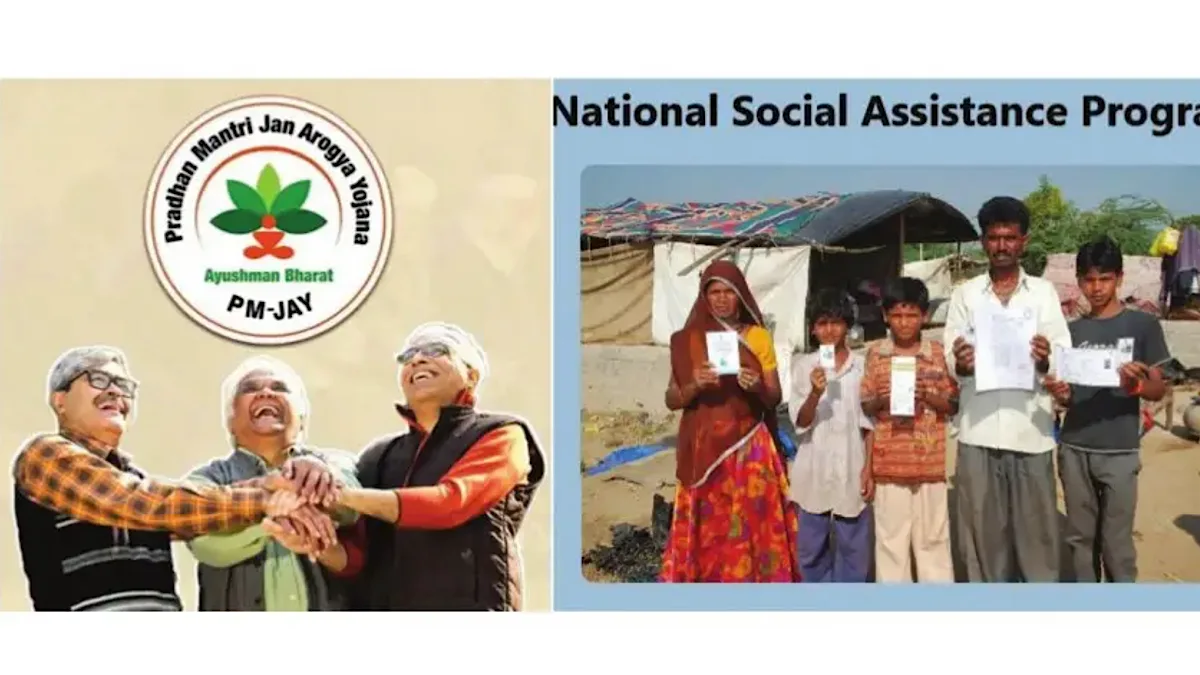
Some notable social security initiatives in India may be mentioned here as Pradhan Mantri Shram Yogi Maan-Dhan (PM-SYM) ~ a pension scheme for workers in the unorganized sector; Atal Pension Yojona (APY) ~ a voluntary pension scheme for citizens aged 18-40; National Social Assistance Programme (NSAP) ~ a programme providing financial assistance to elderly, widows, and disabled persons below the poverty line, and Ayusman Bharat-Pradhan Mantri Jan Arogya Yojona (AB-PMGAY) ~ a health insurance scheme for poor families.
One of the primary concerns is the limited coverage of social security programmes. Many schemes, such as those under the Employees’ State Insurance Act and the Employees Provident Funds and Miscellaneous Provisions Act, primarily cater to workers in the organized sector, leaving out a vast majority of the workforce in the unorganized sector. This limitation is particularly problematic given the significant proportion of India’s workforce engaged in informal or unorganized activities.
The exclusion of these workers from social security benefits exacerbates income inequality and increases vulnerability to poverty and economic shocks. Awareness and education about insurance products are also significant issues. Many individuals, particularly in rural areas and among the underprivileged, lack awareness about the benefits and procedures of various social insurance schemes. This lack of awareness can lead to low uptake of these schemes, further marginalizing already vulnerable populations.
Moreover, the complexity of insurance products and the requirements for accessing benefits can be overwhelming for many individuals, highlighting the need for simplified processes and enhanced financial literacy. Affordability is another major concern. Premium costs can be prohibitive for low-income individuals, making it difficult for them to access insurance benefits. This is particularly true for health insurance, where out-of-pocket expenses can be catastrophic for many families. The government’s initiatives, such as the Ayushman Bharat-PMJAY, aim to address this issue by providing subsidized health insurance coverage to vulnerable populations.
However, the sustainability and effectiveness of such schemes depend on various factors, including funding, service delivery, and beneficiary identification. Administrative inefficiencies also plague the social insurance system. Claim settlement delays, beneficiary identification issues, and fund management problems can undermine the effectiveness of social insurance schemes. These issues can lead to frustration and mistrust among beneficiaries, ultimately affecting the overall impact of these schemes. Streamlining administrative processes and leveraging technology can help improve the efficiency and effectiveness of social insurance programmes. Despite these challenges, the government has introduced several initiatives to strengthen the social insurance system.
The Pradhan Mantri Jan Dhan Yojana, for example, aims to provide financial inclusion to all citizens, particularly the underprivileged. The Atal Pension Yojana provides pension benefits to unorganized sector workers, ensuring financial security in old age. These initiatives have the potential to significantly improve the social security landscape in India, but their success depends on effective implementation and sustained support. A comprehensive approach is required to address the social security needs of India’s citizens. This includes not only providing financial protection but also ensuring access to healthcare, education, and protection against various risks. Streamlining the fragmented social security architecture into a simple and inclusive system can help serve all citizens more effectively.
This may involve integrating various schemes, enhancing beneficiary identification and enrollment processes, and improving service delivery mechanisms. Ultimately, a robust and inclusive social insurance system is crucial for promoting economic growth, reducing poverty, and improving the overall well-being of India’s citizens. By addressing the challenges and limitations of the current system, policy-makers can create a more effective and sustainable social security framework that benefits all sections of society.
This requires a concerted effort to enhance awareness, improve administrative efficiency, and ensure the financial sustainability of social insurance schemes. With careful planning and implementation, India’s social insurance system can play a vital role in achieving the country’s development goals and ensuring a secure future for its citizens. India’s social security measures are inadequate, particularly for the informal sector workers who make up a significant portion of the workforce. Some key issues include:
i) Limited coverage ~ only 7.5 per cent of the workforce receives monthly social security benefits;
ii) Insufficient budget allocation ~ the budget allocation for social security is inadequate, leading to a lack of resources for implementing and sustaining social security programmes;
iii) Policy challenges ~ social security policies are not effectively implemented, and there are issues with corruption and leakages in social security programmes, and
iv) Digital divide ~ the digital divide, particularly in rural areas, hinders access to social security benefits and services. In conclusion, India’s social safety net has made significant progress, but challenges persist. Though India has made efforts to improve social security, more needs to be done to address the challenges and ensure adequate coverage and benefits for all citizens. To strengthen the system, policy makers must address gaps in coverage, ensure adequate funding, and improve implementation. A robust social safety net is crucial for reducing poverty and inequality, and promoting inclusive growth. By prioritizing the most vulnerable populations and leveraging technology, India can create a more effective and sustainable social safety net that supports the wellbeing of all its citizens.
(The writer is Associate Professor and Head, Political Science, (Retd. WBES), Chandernagore Government College, Hooghly)